How Thala Works
Thala is designed to mirror how your mind actually works. Not as a filing cabinet, but as an active thinking partner with its own memory systems, attention, and background processing.
The Three-Layer Mind
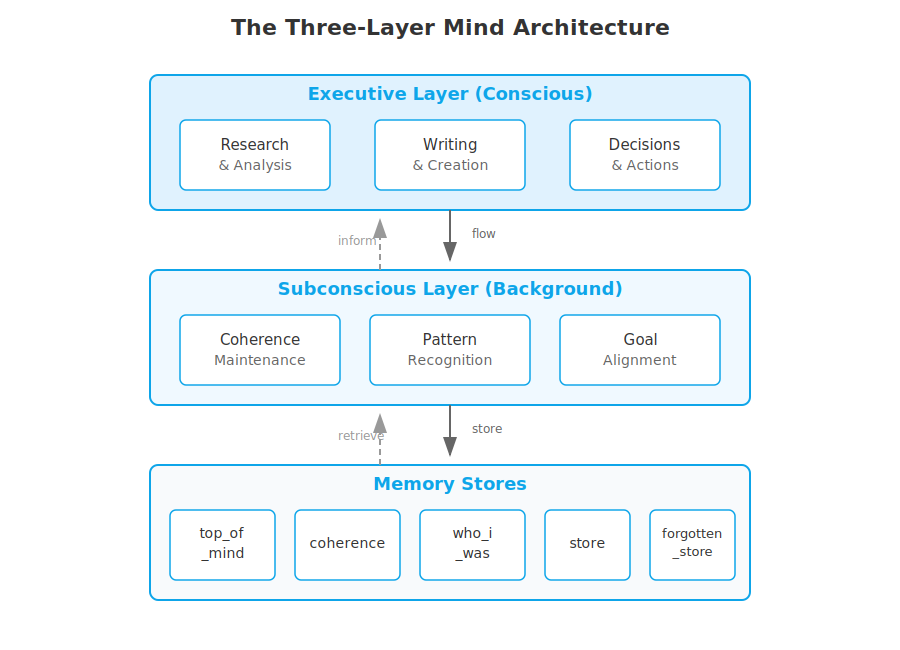
Executive Layer: Your Conscious Mind
When you ask thala to do something—research a topic, write a report, find relevant books—that’s the executive layer at work. It’s goal-directed, deliberate, and runs when you’re actively engaged.
This mirrors how you might sit down to think through a problem: marshaling your attention, pulling relevant memories, working through reasoning step by step.
Subconscious Layer: Your Default Mode Network
When you’re not actively using thala, it doesn’t just sit idle. Background processes maintain coherence (keeping beliefs consistent), recognize patterns across your knowledge, and align stored information with your goals.
This mirrors what your brain does during downtime—the “default mode network” that consolidates memories, makes connections, and maintains your sense of self even while you’re doing dishes.
Memory Stores: How Memories Are Kept
Each store serves a different cognitive function:
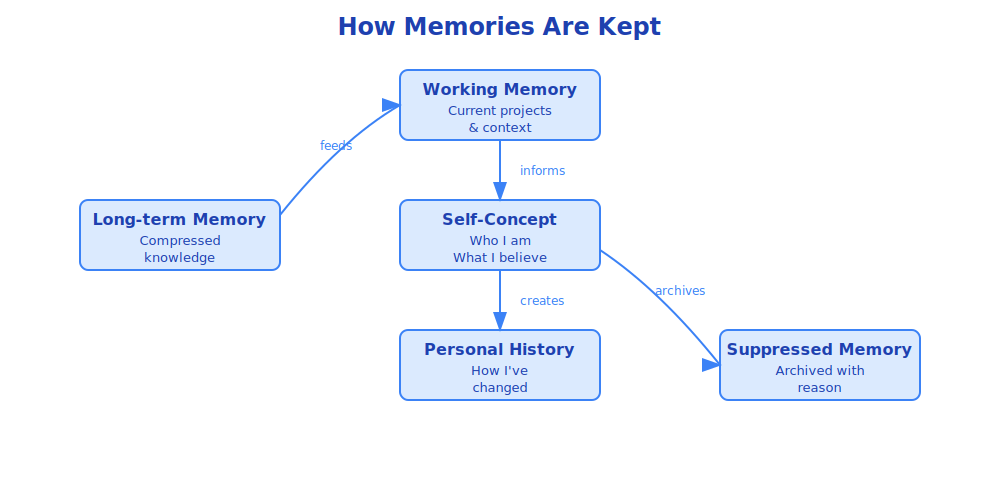
The Five Memory Types
top_of_mind: Working Memory
Your current projects, active context, what you’re thinking about right now. Like the handful of items you can hold in mind while solving a problem.
In thala: Recent research, active documents, current project state. High-fidelity, frequently accessed, quickly updated.
coherence: Self-Concept
The core of who you are—your beliefs, values, mental models, the things you “just know” about yourself and the world. Not raw facts, but processed understanding. Includes confidence levels and caveats.
In thala: Synthesized beliefs and positions, with uncertainty expressed. “I believe X because Y, though I’m less certain about Z.” Heavily referenced, carefully maintained.
who_i_was: Autobiographical Memory
The edit history of your self-concept. How your beliefs have evolved, what you used to think, the trajectory of your thinking over time.
In thala: Previous versions of coherence entries, dated and preserved. Enables understanding of intellectual development and provides context for current positions.
store: Long-term Memory
Everything relevant, compressed 10:1. The map that represents the territory. Not every detail, but enough to navigate back to full fidelity when needed.
In thala: Summarized documents, clustered research, metadata about your knowledge. Dense, searchable, linked to source material.
forgotten_store: Suppressed Memory
Not deleted—archived with reason. Things you’ve intentionally set aside, with notes on why. Sometimes you need to un-forget.
In thala: Items removed from active stores, tagged with the reason for removal. Still searchable, but excluded from default retrieval.
The Flow of Information
When you ask thala to research something:
sequenceDiagram
    participant You
    participant Executive
    participant Stores
    participant Sources

    You->>Executive: "Research topic X"
    Executive->>Stores: Check existing knowledge
    Stores-->>Executive: Relevant context
    Executive->>Sources: Query APIs, databases
    Sources-->>Executive: Raw results
    Executive->>Executive: Process, cluster, synthesize
    Executive->>Stores: Store findings
    Executive->>You: Structured report
The executive layer coordinates: checking what you already know, gathering new information, processing it into useful form, storing it appropriately, and returning a coherent result.
Background processes then maintain the new information—updating coherence if beliefs should change, recognizing patterns with existing knowledge, archiving superseded information with reason.
Why This Architecture?
Most knowledge systems treat information as static: store it, tag it, search it. But that’s not how minds work.
Your brain actively maintains coherence—resolving contradictions, updating beliefs, forgetting what’s no longer useful (while keeping it recoverable). It recognizes patterns without being asked. It runs background processes that surface insights during idle moments.
Thala aims to do the same: not just store your knowledge, but think alongside you.